


What Is a Dental Bridge? Complete Guide to Replacing Missing Teeth

What is a dental bridge?
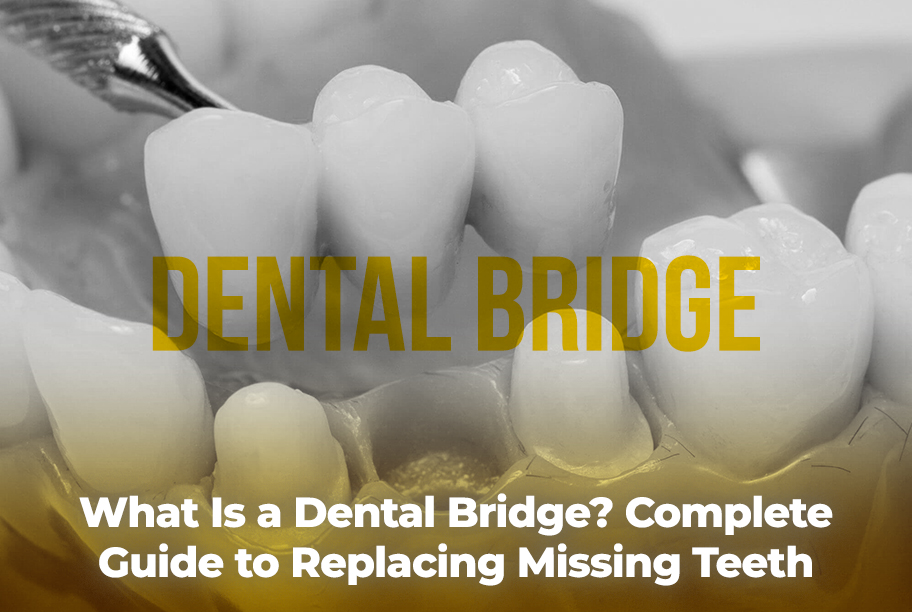
Dental bridges replace missing teeth. Specifically, they can replace one or several lost teeth.
As the name implies, this device quite literally "bridges the gap" in your smile. Dentists can create custom bridges that match the shade of your natural teeth.
A dental bridge is made up of different components:
Abutments are the structures that support your dental bridge. While the term usually refers to natural teeth, it can also describe the small connector posts used in implant-supported bridges.
Pontics are the artificial (false) teeth that fill in the space left by the missing teeth.
Depending on your condition and the kind of bridge you receive, your bridge may include one or more abutments and one or more pontics.
Types of dental bridges
Dentists choose different kinds of bridges based on your oral health goals. The four main types of dental bridges include:
Traditional dental bridge: This is the most common type of bridge. It has crowns (caps) on both ends and pontics (replacement teeth) in the middle. A dentist attaches the crowns to the natural teeth (abutments) on each side of the gap, while the pontics span the empty space. Traditional bridges are used when you have healthy natural teeth on both sides of the gap.
Cantilever dental bridge: A cantilever bridge is similar to a traditional one, but it has a crown on only one side. So, when your dentist attaches the bridge to the abutment tooth, the false tooth (pontic) "hangs" or extends over the space. Dentists use cantilever bridges when there’s only one natural tooth beside the gap. Because of their design, cantilever bridges are not as sturdy as traditional ones.
Maryland dental bridge: A Maryland bridge (also called a resin-bonded bridge) uses metal wings instead of crowns to secure your bridge. A dentist bonds the wings to the backs of your neighboring teeth to hold the bridge in place. Maryland bridges are typically used to replace front teeth, as they aren’t strong enough to handle chewing forces in the back of the mouth.
Implant-supported bridge:This type resembles a traditional bridge, but instead of natural teeth, it is anchored on dental implants. Dental implants are small screw-like posts that replace the roots of missing teeth. Before placing the bridge on the implants, your implants must fully fuse with your jawbone. This process generally takes three to six months, but it may take longer depending on your case. Dentists often recommend implant-supported bridges if you are missing three or more teeth in a row.
To decide which type of bridge you need, your dentist will consider several factors, including:
- Your age. (Dentists typically do not place bridges in children.)
- The number of missing teeth.
- The size of the gap.
- The condition of the teeth next to the gap.
- Whether you have natural teeth on both sides of the space.
- The overall health of your teeth and gums.
- Your personal preferences.
What happens during a dental bridge procedure?
It depends on the type of dental bridge you receive:
Traditional or cantilever bridge
To place a traditional or cantilever bridge, your dentist will:
- Give you local anesthesia to keep you comfortable during the procedure.
- Reshape your abutment teeth (the natural teeth that will support your new bridge). To do this, they’ll need to remove a portion of tooth enamel. This step is irreversible.
- Take impressions of your teeth and send them to a dental lab. There, a lab technician will use the molds to create your permanent bridge.
- Place a temporary bridge to protect your teeth while the final version is being made. It usually takes two to four weeks to fabricate a dental bridge.
At a second office visit — once your final bridge is ready — your dentist will:
- Remove the temporary bridge.
- Try in the new bridge and check the fit.
- Bond (cement) the final bridge into place.
Some dentists use CAD/CAM (computer-aided design and manufacturing) technology to create custom bridges in their office during the same visit. Ask your dentist if this is an option for you.
Maryland bridge
To place a Maryland bridge, your dentist will:
- Prepare your teeth to accommodate the metal wings.
- Take impressions of your teeth and send them to a laboratory. (A lab technician will use them to craft your permanent bridge.)
When the final bridge is ready, your dentist will schedule a second visit. During this appointment, they will:
- Try in your new Maryland bridge and check for proper fit.
- Etch the backs of your neighboring (abutment) teeth to help the bonding material adhere.
- Attach the metal wings to the backs of your abutment teeth using dental resin cement.
Implant-supported bridge
An implant-supported bridge requires multiple office visits, including a surgical procedure.
At the initial appointment, a dentist, periodontist, or oral surgeon will:
- Numb your mouth with anesthesia to ensure comfort.
- Surgically place dental implants into your jaw during the procedure.
Following surgery, your implants will need time to heal and fuse with your jawbone (a process known as osseointegration). This usually takes three to six months but may take longer depending on your specific case.
Once your implants have integrated, your dentist will:
- Attach impression posts to the implants and take impressions of your mouth. (Impression posts are small connector rods that extend slightly above your gumline.)
- Take impressions with the posts in place and send them to a dental lab.
- Remove the impression posts while you wait for your final bridge to be made.
When your implant-supported bridge is ready, your dentist will:
- Place the implant abutments and test the fit of the attached bridge.
- Secure your bridge in place. Your dentist may use either dental cement or small screws to do this. (It shouldn't cause any pain.)
Because implant-supported bridges require time for your implants to fuse with your bone, this type of restoration typically takes longer than other bridge options.
Risks / Benefits
What are the pros and cons of a dental bridge?
Dental bridges offer a range of benefits. However, there are also some drawbacks to consider:
Advantages of dental bridges
Dental bridges can:
- Provide a natural-looking solution for missing teeth.
- Restore chewing ability and speech function (missing teeth can make eating or speaking more difficult).
- Prevent nearby teeth from shifting into the empty space left by missing teeth.
Disadvantages of dental bridges
There are also a few downsides to dental bridges:
- Decay or injury can damage your abutment teeth, weakening your bridge.
- If the supporting (abutment) teeth aren’t strong enough, they can fracture under pressure.
- If you don’t properly clean your bridge and the gum tissue underneath, plaque and bacteria can lead to gum inflammation or tooth decay.
Recovery and Outlook
How long does it take to recover after a dental bridge procedure?
Recovery time varies from person to person and depends on several factors. On average, it takes about one to two weeks for your teeth and gums to heal. However, it may take a bit longer for your new bridge to feel completely natural and comfortable.
How long does a dental bridge last?
On average, a dental bridge lasts between five and 15 years. Some bridges may last even longer with proper oral hygiene and regular care.
You may hear dentists refer to them as “permanent bridges.” This simply means that only a dentist can remove them — it doesn’t mean they last forever. You’ll still need to replace them if they show signs of wear or damage over time.
How can I take care of my dental bridge?
Caring for a dental bridge is similar to caring for your natural teeth. To keep your bridge in good shape:
- Brush and floss every day.
- Use a non-abrasive toothpaste that contains fluoride.
- Clean under your bridge daily with floss threaders or interdental brushes (small tools designed to reach between teeth).
- Avoid extremely hard or sticky foods.
- Don’t chew on ice, pens, pencils, or your fingernails.
- See your dentist regularly for checkups and cleanings.
Additional Frequently Asked Questions
Bridge vs. Implant: Which one is better?
In general, dental implants last much longer than bridges. Implants also help preserve existing bone and reduce the risk of future bone loss.
However, everyone has unique oral health needs, goals, and preferences. Talk to your dentist to determine which treatment option is best for you.
What’s the ideal age for a dental bridge?
Most dentists don’t place dental bridges in individuals younger than 17 or 18, but there are exceptions. For instance, if a child loses a permanent tooth, a dentist might place a Maryland bridge. Even then, other options like a temporary partial denture (sometimes called a “flipper”) might work better.
How many teeth can a bridge replace?
Most commonly, a dental bridge replaces one to three missing teeth in a row. In some cases, a bridge can replace up to four consecutive teeth. But remember, longer bridges usually need more support. So, to replace four missing teeth with a bridge, you’ll need healthy natural teeth on both sides of the gap.
To learn more about your tooth replacement options, consult your dentist.
How long can you wait to get a dental bridge?
In general, you should replace missing teeth as soon as possible to prevent neighboring teeth from shifting. However, if you first need a tooth extraction, you may need to wait a few months before getting a bridge. This allows time for your gums and the underlying bone to heal.
Does getting a dental bridge hurt?
Receiving a dental bridge shouldn’t be painful. Your dentist will give you local anesthesia to numb your gums before starting the procedure.
Do bridges feel like real teeth?
It may take some time to get used to your new dental bridge. But once you do, it should feel similar to your natural teeth. Think of it like wearing a new ring — you notice it at first, but eventually, it just feels normal.
Can a dental bridge be removed and re-cemented?
It depends. If your bridge is already loose, removal is usually simple. Your dentist can typically re-cement it without issue. However, if the bridge needs to be removed to treat something like gum disease or underlying decay, it may break during the process. If that happens, you’ll need a new bridge.


